


Trade show freight is built to travel, but even the best-planned shipment can run into the unexpected. A crate can be damaged in transit, freight can be lost, or an accident can happen on the road. That is why it is important to understand what protection applies before your exhibit leaves the dock.
Carrier liability and cargo insurance are not the same thing. If the replacement value of your exhibit matters, know what coverage you have before the shipment moves.
One of the biggest misconceptions in freight is that every shipment automatically carries insurance equal to the full value of the goods. That is not necessarily the case.
Exhibitway Logistics is a licensed freight broker. We arrange transportation with motor carriers on behalf of our customers. Under our current Freight & Service Terms, Exhibitway is not the motor carrier, and loss or damage caused by a carrier or warehouseman is generally subject to the applicable liability terms and limitations.
For domestic air, truck, and warehouse shipments under Exhibitway's terms, standard liability is limited to $0.50 per pound or $40 per article, whichever is less. Different limitations apply to international air and ocean shipments.
If your Exhibitway quote says “Standard Carrier Liability,” it does not mean your shipment is insured for its full replacement value.
It means the shipment is moving under the standard liability terms that apply to the transportation service.
Here is the simple version: if freight is lost or damaged and the carrier is legally liable, the amount recoverable may be limited by weight, article, tariff, contract, or other applicable terms. It is not automatically based on what your exhibit cost to build or replace.
For example, under Exhibitway's current Freight & Service Terms, domestic air, truck, and warehouse shipments are subject to a standard liability limit of $0.50 per pound or $40 per article, whichever is less. Different limits apply to international air and ocean shipments.
So, if a crate contains a high-value custom exhibit, the standard liability amount could be much lower than the exhibit's actual replacement value. That is the key reason to understand the difference between standard carrier liability and optional cargo insurance before shipping.
If your quote shows “Standard Carrier Liability,” no additional cargo insurance has been purchased through Exhibitway for that shipment. If you want coverage based on a declared replacement value, ask your Exhibitway representative about optional cargo insurance before the shipment moves.
That standard liability should not be confused with cargo insurance purchased for the declared replacement value of your shipment.
No. Cargo insurance is not automatically included in Exhibitway service fees.
If you want cargo insurance, it must be requested before the shipment moves. The actual replacement value of the goods must be declared in writing, and the applicable insurance fee must be paid.
When cargo insurance is requested and procured through Exhibitway, coverage applies to physical loss or damage subject to the applicable policy terms, exclusions, and deductible.
Under Exhibitway's current Freight & Service Terms, the deductible is 5% of the shipment value, with a minimum deductible of $750 and a maximum of $2,500. For shipments valued above $100,000, Exhibitway may adjust the deductible and will advise the customer.
Because insurance terms matter, we recommend discussing high-value freight with your Exhibitway representative before pickup rather than waiting until the shipment is already in transit.
You can review the complete Exhibitway Logistics Freight & Service Terms for the current contractual language governing liability, insurance, claims, and other shipment terms.
The answer depends on what you are shipping and how much financial exposure your organization is comfortable carrying.
Trade show freight can include custom exhibits, AV equipment, prototypes, machinery, product samples, computers, lighting, furniture, and other assets that are expensive or difficult to replace quickly.
Before shipping, ask a few practical questions:
If the shipment value is significantly higher than the standard liability available under the applicable terms, requesting cargo insurance may make sense.
The important part is making that decision before pickup.
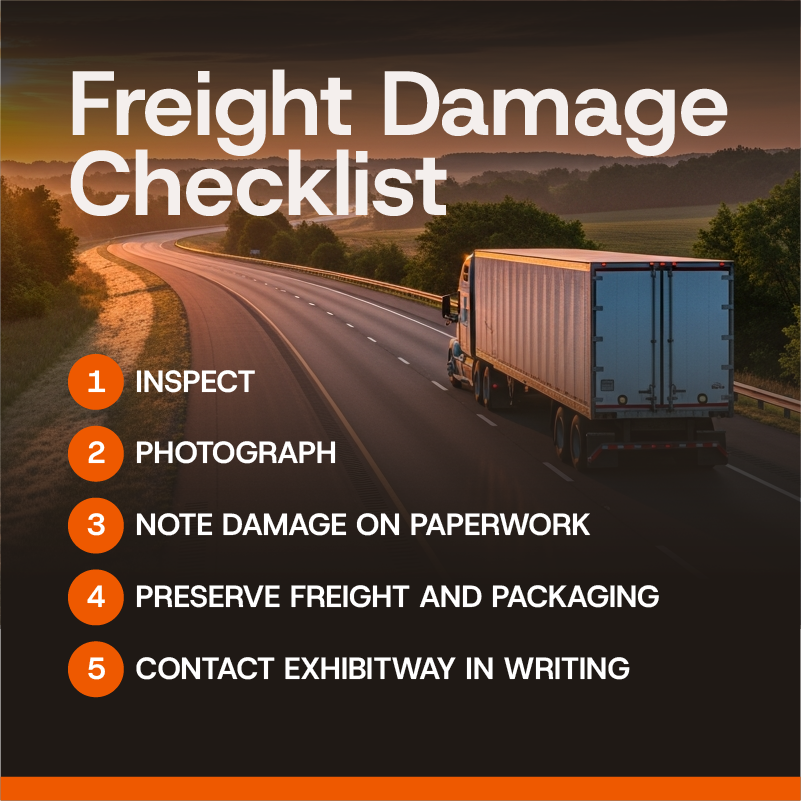
If freight arrives damaged, documentation matters.
Inspect the shipment when it is delivered whenever possible. If you see visible damage, document the condition before the freight is moved, unpacked, repaired, or discarded.
Take clear photos of:
Note visible loss or damage on the delivery paperwork or Bill of Lading when applicable. Keep the damaged goods and packaging available in case an inspection is required.
Then contact Exhibitway as quickly as possible so our team can help collect the documentation and assist with the claims process.
Do not throw away damaged packaging until the claim has been reviewed. The packaging can help establish how the freight was protected and what may have happened in transit.
Do not wait.
Exhibitway's current Freight & Service Terms require written notice of loss or damage within 10 days of delivery for air and ground shipments. Ocean shipments also require written notice within 10 days, with initial notice within 3 days. Written notice of delay is required within 5 days of the anticipated delivery date.
Oral notice should be confirmed in writing.
Those deadlines are one more reason to inspect freight promptly and contact the Exhibitway team as soon as something does not look right.
The exact process depends on the shipment, carrier, type of loss, and whether cargo insurance was procured.
Exhibitway can help gather and submit the documentation needed to support the claim. Depending on the circumstances, the carrier, insurer, or claims administrator may request photographs, shipping documents, invoices, repair estimates, proof of value, inspection access, or other supporting information.
A claim is not automatically approved simply because damage occurred. The responsible party will review the documentation against the applicable carrier terms, liability rules, or insurance policy.
It is also important to keep shipment invoices current. Under Exhibitway's Freight & Service Terms, Exhibitway has no obligation to consider or assist with a claim when invoices related to the shipment remain unpaid.
Insurance is a safety net. Good freight preparation is still the first line of defense.
For trade show shipments, that means thinking about how the freight will move through the entire journey, not just the highway miles.
A few basics make a difference:
Trade show freight also goes through venue docks, marshalling procedures, material handling, empty-container storage, move-out, and outbound loading. The transportation plan and the packaging plan should account for the whole trip.
Before a high-value shipment moves, make insurance part of the freight conversation instead of an afterthought.
Know the replacement value of the exhibit. Understand the liability that applies to the service. Check whether your organization already carries relevant insurance. If you want Exhibitway to arrange cargo insurance, request it in writing before shipment and provide the actual replacement value.
Most importantly, do not assume that the value of the exhibit and the amount recoverable after a loss are automatically the same.
This article is intended as a general summary of portions of Exhibitway Logistics' current Freight & Service Terms and is not a substitute for the complete terms, a carrier's governing tariff or contract, or an applicable insurance policy. The terms governing a specific shipment may vary. Review the current Freight & Service Terms and your shipment documentation for the provisions that apply.
If you are planning an upcoming trade show shipment and want to discuss cargo insurance before pickup, talk with your Exhibitway Logistics representative. We can review the shipment value with you and arrange optional cargo insurance when requested and available.